
Aiken City Directory Holdings
The clearest named Aiken city directory shelf is the Aiken County Historical Museum Reference Library catalogue. It documents individual Aiken City Directories for 1956, with three copies, 1960, and 1966 in Archives. The public catalogue does not identify a publisher, so title pages must be checked before one is named. Those entries establish particular holdings, not a continuous annual run or full coverage of everyone in Aiken.
| Collection | Documented years | Holding route | Access and use |
|---|---|---|---|
| Aiken City Directories | 1956, 1960, 1966 | Historical Museum Reference Library and Archives | Inspect the volume, title page, and printed sections in person. |
| Aiken Rambler | 1979-1983 | Historical Museum catalogue | Check the format and index before treating it as a directory. |
| Aiken phone books | 1982, 1983, 1985-1986, 1987-2017 | Historical Museum Archives | Listing-era address or phone evidence, not a full roster. |
| Aiken city census | 1868 | South Carolina Department of Archives and History | Direct municipal historical name-and-place lead. |
| Municipal service records | Varies by type | South Carolina Department of Archives and History | Tests an address, applicant, improvement, or tax context by period. |
The Museum's vertical-files index also lists Aiken City Directories with Aiken Family, Maps, Public Libraries, newspaper, surname, and historic-house subjects. It can identify a focused request for a family or address. It is selective reference material, not a current resident roll.
See the Museum's documented subject-file inventory before requesting a folder or volume.
The inventory helps narrow an archive request to a directory, family, map, or historic-house subject.
Aiken City Directory Years
The Museum catalogue's narrow date list is useful because it is documented. Its directory volumes are 1956, 1960, and 1966. Later phone-book holdings list 1982, 1983, 1985-1986, and 1987 through 2017. A gap does not show that a family left Aiken. It may reflect a missing volume, another publication type, a listing choice, or a catalogue limit. Record the object consulted and the year printed on it.
The same catalogue lists Aiken Rambler for 1979 through 1983. Its presence supports a request for local reference material, not an assumption about its arrangement. Augusta phone books for 1998-1999 are listed separately and should remain regional corroboration, never proof of Aiken residence.
The Museum catalogue supplies the holdings evidence.
Use the catalogue as a shelf lead, then inspect the physical item for its edition, title wording, and printed arrangement.
Note: A catalogued year confirms a holding, not a publisher, uninterrupted publication, or universal local coverage.
Reading an Aiken City Directory
An Aiken city directory is a compiled reference publication, not official proof. A normal alphabetical section moves from a person to a printed address. A street or criss-cross section, when a volume actually has one, reverses the path from street and number to a listed name. The Library of Congress explains that such publications can carry personal or professional information, including occupation, employer, spouse, address, or telephone number. Each item needs to be read on its own terms.
| Printed element | What to capture |
|---|---|
| Name line | Copy surname, given name, initials, and spelling exactly as printed. |
| Household wording | Preserve spouse or widow notation only when the same volume prints it. |
| Work detail | Record an occupation or employer only if the entry includes one. |
| Address or telephone | Keep the source year, street spelling, number, and any printed phone detail together. |
| Street entry | Copy the street, number range, listed name or business, and page or column. |
No digitized Aiken entry was available for inspection in the research. No specific local abbreviation key, person, ownership label, address, or employer should be guessed from an unseen page. A photographed entry and title page supply the evidence needed for a careful transcription.
Aiken Directory Entry Terms
Directory language changes by publisher and year. The distinctions below keep an address inquiry from becoming a claim the printed source does not make.
- Criss-cross directory
- A section arranged first by street and number, useful only when the item includes that layout.
- Householder index
- An arrangement that identifies a named household contact and may not enumerate every person there.
- Abbreviation key
- The edition's own guide to shortened terms, never borrowed from another volume.
- Listing date
- The publication or survey period, which can differ from a census or land-record date.
A name, address, or telephone listing becomes stronger when its source role is stated plainly. A subscriber, business addressee, and property party are different types of evidence. That discipline matters when several Aiken collections overlap only partly.
Aiken City Directory Tracing
Trace a household one dated source at a time. Start with an old address or property account, then inspect the Museum's documented 1956, 1960, and 1966 volumes separately. Preserve spelling variants rather than selecting one apparent match. For later questions, inspect the listed Aiken Rambler and phone-book years that fit the period. If a source lacks a street section, turn to deeds or tax material instead of inventing a reverse-directory result.
- Record street spelling, number, parcel, and legal description as separate items.
- Inspect the relevant Aiken volume and retain its name, address, source type, and edition date.
- Use an alphabetical entry to locate an address, then use a street section only if that item contains one.
- Pair the observation with the nearest public federal census year, keeping both dates distinct.
- Bridge the interval with a deed, tax, utility, permit, probate, cemetery, or map record.
The National Archives releases federal census schedules after 72 years, and 1950 was the newest public federal census at the time of this research. A census answers who was counted on its enumeration date. A directory reflects a publisher's record from another point in the year. A later finding can be checked through an Aiken resident lookup when the question shifts to a current official record.
Aiken's 1868 Census Lead
The South Carolina Department of Archives and History municipal guide lists a City of Aiken census from 1868. It is an unusually direct early name-and-place lead, although it is not a current directory. The guide also identifies City Council minutes from 1842-1992 and city papers around 1855-1911, which can add period context when a family or address appears in a dated source.
Aiken County was created in 1871 from parts of Orangeburg, Edgefield, Barnwell, and Lexington counties. A record before that date may belong in a parent jurisdiction. Documenting the event date and place prevents an empty Aiken County search from being mistaken for a negative answer.
Note: The 1868 municipal census is a historical research route, not evidence about a present-day address or household.
Aiken Archive Address Clues
City directories are one layer of Aiken historical research. SCDAH lists business-license volumes for 1897-1936, building-permit volumes for 1925-1936, tax duplicate books for 1895-1916, water registers for 1904-1953, and sewer-service applications for 1932-1955. Each can attach a date or activity to an address, but each describes a different role. A water applicant is not necessarily every person at an address, and a license holder is not necessarily an owner.
Municipal Court docket volumes cover 1839-1926, while Supervisor of Registration voter stubs cover 1926-1938. Those sources add historical leads only when their date and source role are preserved. The documented access route is the State Archives guide and its research channels, not an assumption that every series is online.
Aiken City Directory Research Stops
Aiken has several research stops with separate roles. The Museum supplies the clearest catalogued directory and subject-file holdings. SCDAH keeps municipal and county archive series. The Aiken County Public Library is part of the ABBE Regional Library System, and its Aiken County branch has a microfilm reader and printer. ABBE cards are free for people who live, work, attend school, or pay property taxes in its four-county region, but title and year availability should be confirmed with reference staff.
The Aiken County Historical Society is a local referral channel with a preservation and documentation mission. Its orientation can help identify a starting collection, while the Museum and SCDAH provide the more specifically catalogued archival routes.
Consult the Historical Society's local-history orientation before selecting a Museum, library, or archive request.
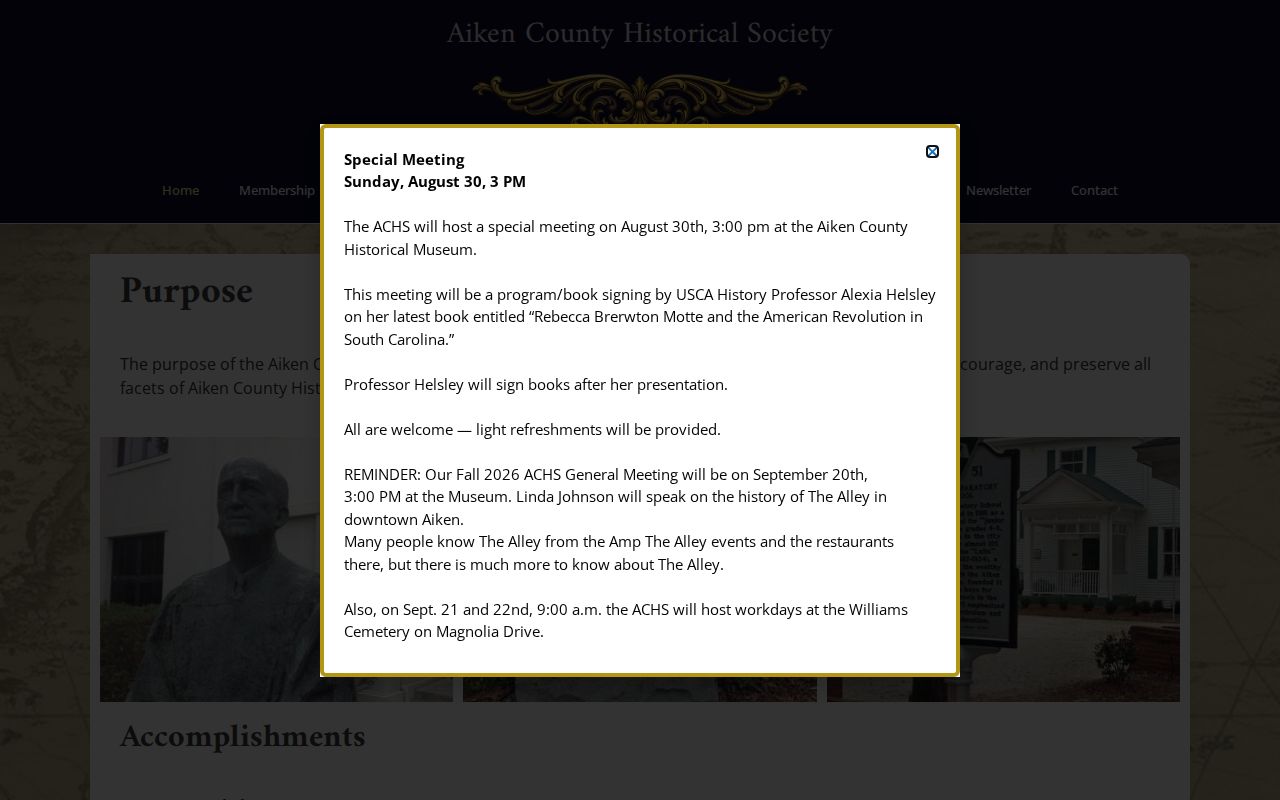
The Society is a referral point, while an item citation or archive guide identifies the record that supports a conclusion.
Aiken Directory Timeline
Aiken's historical shelf is not one uninterrupted sequence. The known timeline joins municipal record layers, a few catalogued directory years, and later phone-book material without claiming a publication history that the sources do not establish.
- 1837 forward: City Clerk/Treasurer cashbooks begin, followed by court dockets in 1839 and Council minutes in 1842.
- 1868: SCDAH lists the City of Aiken census.
- 1956, 1960, 1966: the Museum catalogue documents individual Aiken directory volumes.
- 1979-1983: the catalogue lists Aiken Rambler.
- 1982-2017: catalogued phone-book holdings provide later checkpoints, with stated gaps and duplicate entries.
Use the year printed in the object, not a presumed continuous run, when building a family or address chronology. A map, deed, or archive series can then test what the directory observation means. That preserves the evidence for an entry while avoiding a false claim that missing years tell a complete story. It also leaves room for a later catalogue discovery without rewriting the earlier research record.
Physical-place sources add a separate date layer. The Library of Congress describes a 13-sheet Aiken Sanborn map from July 1909, and the archive research notes a 1918 fire map plus 1951-1952 aerials. Those maps can test a street, lot, building footprint, or period setting after a directory has supplied a date. They are not name indexes. Pair a map observation with the dated directory entry, deed, tax, permit, or archive record that identifies the relevant person or address.
Archive staff can then confirm the relevant reel, volume, and access conditions.