
Aiken Previous Residents by Era
Previous residents of one Aiken address must be separated from recorded land parties and service applicants. Start with the current parcel identity, then work backward through the source that covers the period in question. The Aiken County Register of Deeds holds property instruments from 1872, but its online index begins in 1982. Older material depends on the ROD office books and State Archives holdings. A city directory or phone book may provide a dated listing, while a map tests the physical place rather than a person's presence.
| Source | Years it covers | Where held | What it can show |
|---|---|---|---|
| Aiken County ROD records | 1872-present | ROD office | Recorded instruments and legal-description trail; web index begins 1982. |
| ROD imaged documents | After June 12, 2005 | ROD office computers | Electronically imaged recorded documents under the County's stated cutover. |
| SCDAH conveyance books | 1872-1951 | South Carolina Department of Archives and History | Historic transactions and legal descriptions on 131 microfilm reels. |
| Aiken City Directories | 1956, 1960, 1966 | Historical Museum Archives | Individual catalogued volumes; inspect title, format, and entry. |
| Aiken phone books | 1982-2017, with listed gaps | Historical Museum Archives | Listing-era phone and address evidence, not complete population coverage. |
| City water and sewer records | 1904-1953; 1932-1955 | SCDAH municipal records | Service or application chronology, not every household member. |
| Federal census schedules | Public through 1950 | National Archives and licensed genealogy research | Household on an enumeration date, not every year. |
| 1909 Aiken Sanborn map | July 1909 | Library of Congress | Building footprint, material, use, and street pattern, not people. |
For an old address, record the earliest and latest dates found for each source instead of smoothing them into a continuous story. A property party, listed subscriber, taxpayer, service applicant, and census household can all be related to the same place without being interchangeable.
Aiken Previous Residents Parcels
A street address is a location key, not a reliable list of residents. The Aiken County qPublic property search is the practical beginning because County instructions identify Owner Name, Address, Parcel Number, and Legal Description as its search modes. Preserve the situs address, parcel number, legal description, owner field, and report date separately. The legal description is the durable backward identifier when a number changes or a parcel is subdivided.
County GeoServices maintains the GIS enterprise geodatabase and 911 addressing for the county except incorporated North Augusta. Its map hub leads from a selected property report to a map and includes Property, County Address, Subdivision, Road, and Parcel searches. If an old spelling, rural route, or driveway will not match a parcel, ask GeoServices or 911 Addressing for the correlation process rather than assuming a nearby modern address is the same property.
Aiken Previous Residents Deed Chain
The Aiken County ROD Documents search confirms the recorded-land stage. It supports name or business searching and book/page searching, with document-type and date filters. Its result grid includes record date, book/page, and property-description columns. It is not a street-address directory. Begin with the current owner and match the deed's property description before treating a seller as part of the same parcel chain.
- Use the property account to record the present parcel, owner context, and legal description.
- Find the current owner's acquisition using the ROD party search or a known book and page.
- Compare the recorded description, lot, block, subdivision, or metes-and-bounds wording to the parcel.
- Search the seller from that deed as a grantee in earlier records, then repeat the comparison.
- When the trail passes the online-index period, move to ROD books and SCDAH historic conveyance material.
- Grantor
- The party conveying an interest in a recorded instrument.
- Grantee
- The party receiving that interest in a recorded instrument.
- Chain of title
- The linked sequence of recorded instruments for the same property interest.
- Legal description
- The recorded parcel wording that is more stable than a street address for backward research.
Open the Aiken County Register of Deeds information before relying on a result or planning a counter visit.
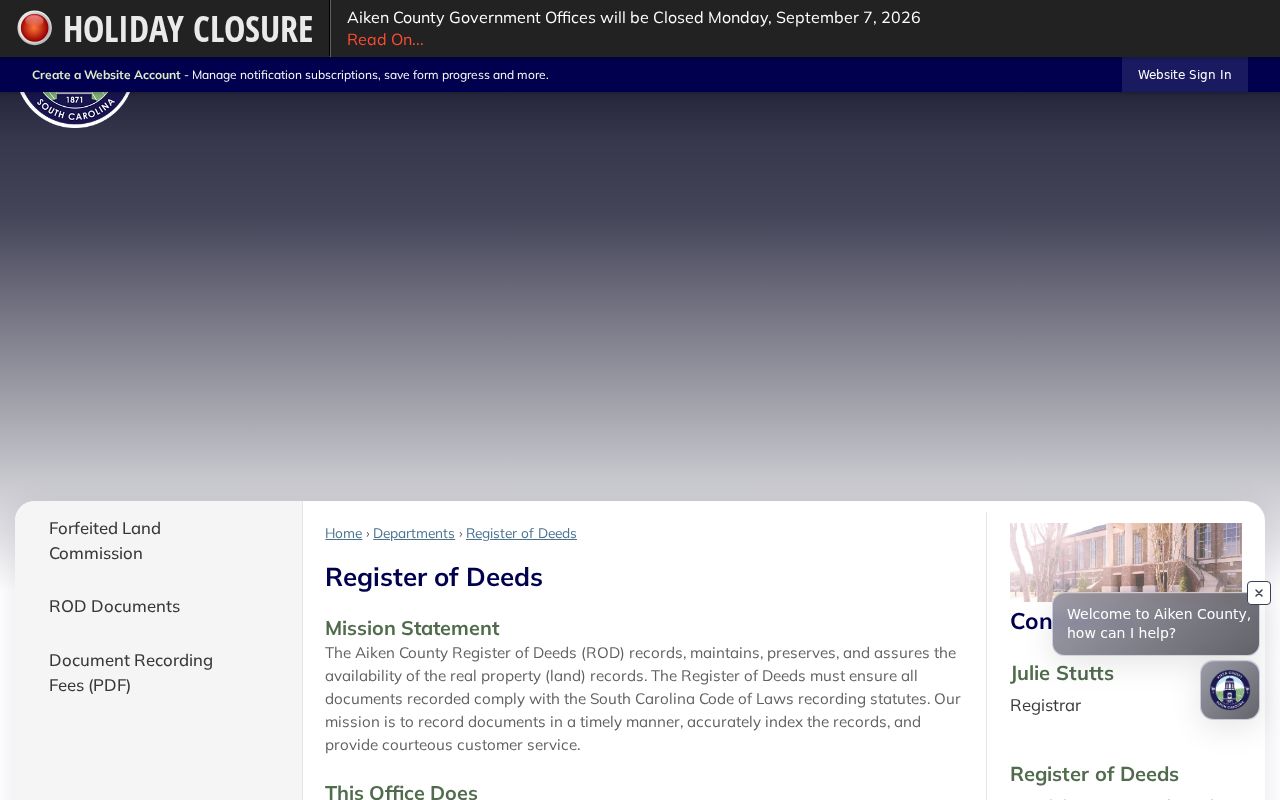
The ROD is the custodian for the recorded instrument chain, while an older occupant needs a separate dated source.
The ROD search form shows the documented name, business, and book-page routes for an Aiken previous residents deed inquiry.
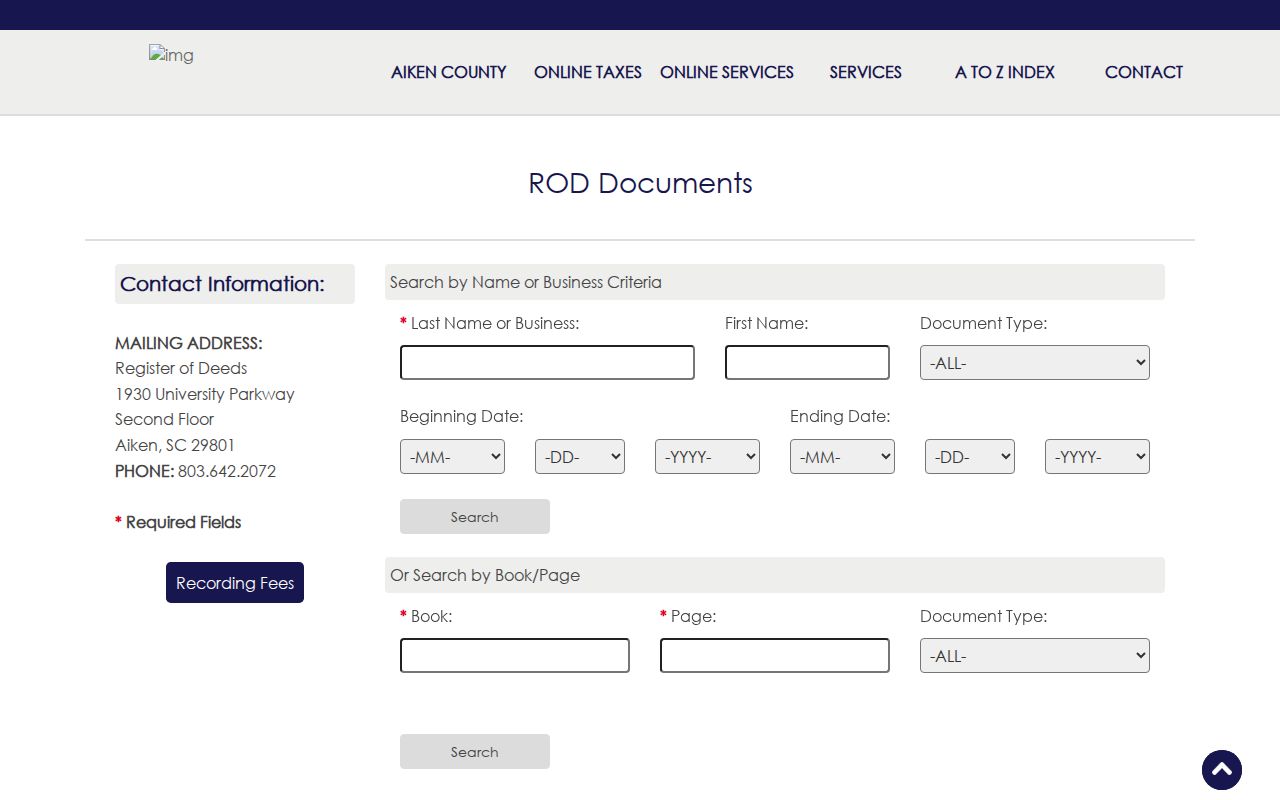
Use the description and book-page details from a matched record to avoid joining similar names to the wrong parcel.
Aiken Previous Records Cutovers
Aiken's recorder access has three meaningful dates. County records reach 1872, the online ROD index begins in 1982, and documents recorded after June 12, 2005 are electronically imaged and viewable on ROD-office computers. Earlier material remains in book form. A blank online search therefore does not establish that a county record is absent.
SCDAH provides a concrete older bridge: Aiken County conveyance books from 1872-1951 on 131 microfilm reels. It also lists miscellaneous RMC records for 1872-1920, agricultural lien abstracts for 1883-1909, labor-contract indexing for 1908-1928, and plat books for 1952-1985. The date of the transaction determines the appropriate counter, book, or archive route.
Note: Retain the record date and property description before moving a deed search from the web index to books or microfilm.
Aiken Previous Residents in Directories
Land records identify parties to property filings, while historic listings can offer a household-level lead. The Historical Museum catalogue documents Aiken directory volumes for 1956, 1960, and 1966, along with named phone-book holdings from 1982-2017 with the stated gaps. The collections and careful entry reading are detailed in the Aiken city directory collections. Use a street or criss-cross section only if the particular physical volume contains one.
Pair each directory observation with a public federal census schedule without merging the two dates. Census schedules released after 72 years were public through 1950 at the time of research. The census reports a household on its enumeration date. A directory records a publisher's listing at another time, and a phone book may omit unlisted people.
- Choose the directory or phone-book year closest to the address question.
- Copy the printed name, street spelling, number, and source date exactly.
- Locate the closest public census year and retain its enumeration date.
- Compare names and location with the deed description, tax record, or municipal series.
- Label each conclusion by source role rather than calling every listed person a resident.
Request the documented Museum catalogue volume before copying an entry.
The catalogue establishes which Aiken directory and phone-book years are held locally, not the contents of an uninspected listing.
Aiken Previous Residents Maps
Historic maps test a physical place, not a person's presence. The Library of Congress makes the 13-sheet July 1909 Aiken Sanborn map available as public-domain material. SCDAH also lists a 1918 fire-insurance map and 1951-1952 aerial surveys in its City of Aiken guide. Read each map by its edition year. A 1909 footprint should not be carried into a later period without a permit, aerial, deed, or other dated support.
Use the map with the legal description, directory date, or municipal service record. It can help distinguish a building, lot pattern, or street label when an address has changed. It cannot identify an occupant by itself. No complete historical street-renumbering chronology was located, so an unmatched historic number should be taken to GeoServices or the archive with the old and current wording, nearest cross street, parcel description, and map or plat evidence.
Aiken Previous Residents Archives
The SCDAH City of Aiken municipal-records guide supplies address-period context beyond deeds. It lists building permits for 1925-1936, water registers for 1904-1953, sewer applications for 1932-1955, business-license volumes for 1897-1936, and municipal tax duplicate books for 1895-1916. County tax duplicates span 1873-1950 in the county guide. These sources can date an improvement, service request, tax relationship, or listed activity.
Each source has a boundary. A permit applicant is not every person at the address. A water account does not prove a whole household. The archive research request should name the address, period, record type, and any parcel or legal-description information rather than ask for every record connected to a household.
Review the SCDAH municipal guide before selecting a historic permit, tax, water, or sewer series.
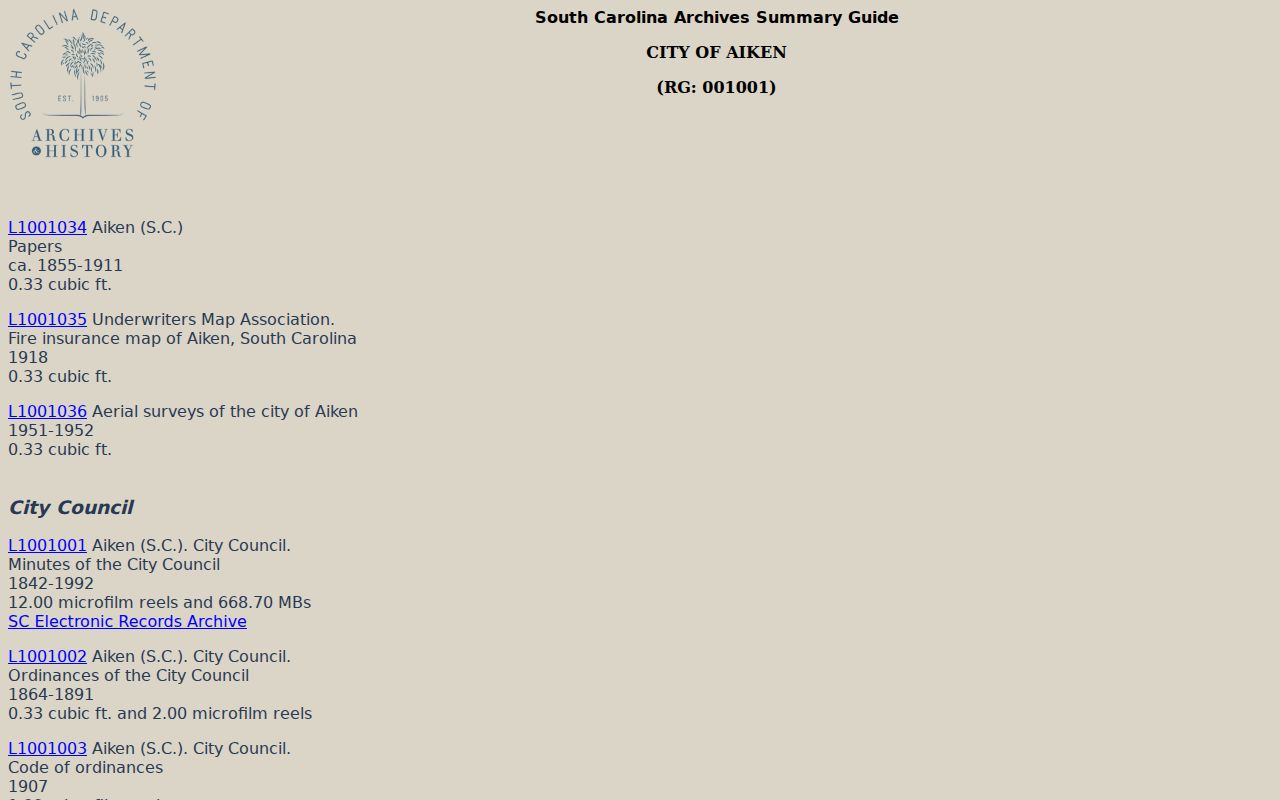
The archive guide identifies the distinct Aiken series and their date ranges so a request can match the period of the address question.
Aiken Previous Residents Origins
Aiken County was created in 1871 from portions of Orangeburg, Edgefield, Barnwell, and Lexington counties. That history changes the first stop for a pre-1871 land, family, or court question. A post-1872 Aiken recorder result cannot settle an earlier event without checking the relevant parent jurisdiction. This is a practical records boundary, not just local history.
The city archive layers can be older than the county recorder trail. City Clerk/Treasurer cashbooks begin in 1837, municipal-court dockets in 1839, and City Council minutes in 1842. Keeping city and county custody distinct makes a past-residents timeline more accurate when an address question crosses the county's creation date.
Aiken Past Residents Limits
An address history can show dated relationships to a property, not a complete private life. An owner, grantor, grantee, taxpayer, subscriber, permit applicant, or water applicant has a source-specific role. A current mailing address, delivery recipient, protected address, and non-owner household member are not established by the land chain. State privacy protections can also limit what official websites display.
Lawful use. Use Aiken previous-residents research for family history, estate questions, property history, or personal civic curiosity. Do not use record details to track, stalk, harass, or harm a living person.
When evidence conflicts, retain the citation, date, and source role, then ask the named custodian or archive for the underlying record. That approach protects both the historical record and the people connected with an address.
A focused question also makes the fallback useful. Supply the address, the date range, the parcel or legal description when known, and the specific record series sought. The ROD office, Historical Museum, ABBE library, and State Archives each provide a different access channel for the portion of an Aiken address trail they actually hold.